

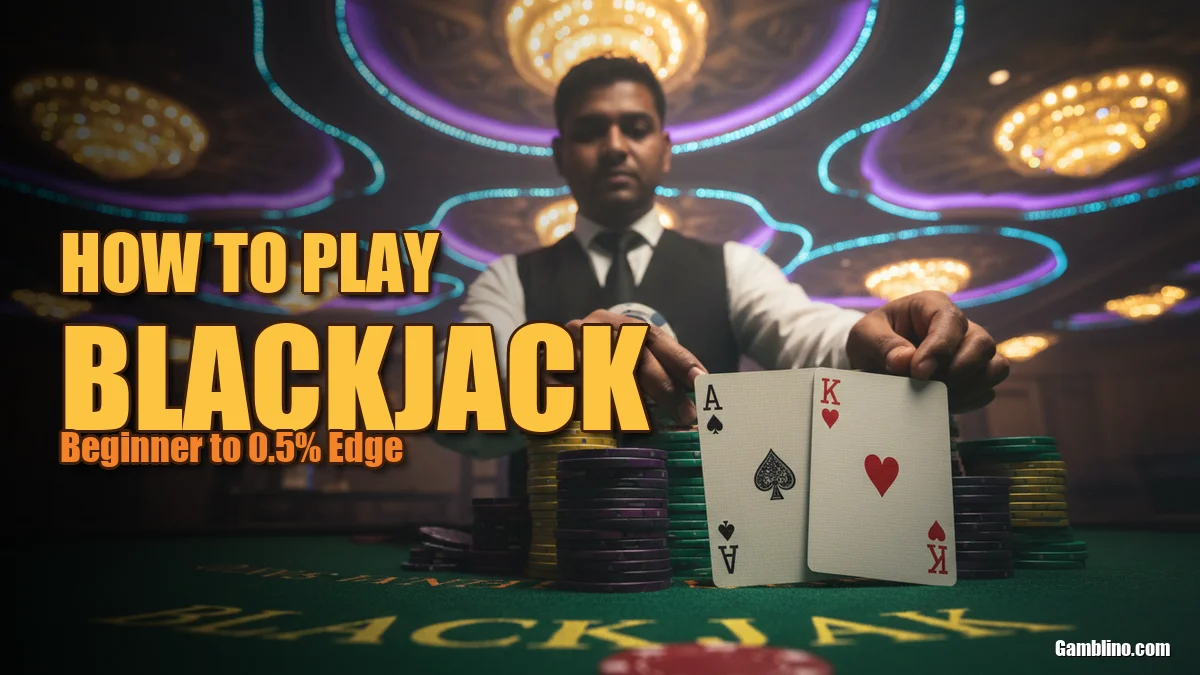
How to Play Blackjack

Blackjack has the lowest house edge of any casino table game when you use basic strategy. The edge drops to around 0.5% against a perfect-strategy player on standard 8-deck blackjack — better than baccarat, significantly better than roulette, and dramatically better than slots. I have been playing online blackjack at Indian-facing casinos for over seven years, and the math is why I keep coming back.
This guide covers every decision point: card values, the five player actions (hit, stand, double down, split, surrender), side bet mechanics, and the basic strategy logic that keeps the house edge at its absolute minimum. For advanced tactics see our card counting guide — though card counting does not work in online RNG tables.
Top Blackjack Casinos in November 2026

- UPI
- IMPS
- Bitcoin
- Ethereum
- Tether
- Visa
- Mastercard
- Bitcoin
- Ethereum
- Tether
- Visa
- Mastercard
- Bitcoin
- Ethereum
- Tether
- UPI
- IMPS
- Skrill
- Neteller
- Bank Transfer
- Bitcoin
- Ethereum
- Tether
- Bitcoin
- Ethereum
- Tether
- UPI
- Bank Transfer
- Visa
- Mastercard
- Skrill
- Neteller
- AstroPay
- Tether
- UPI
- Bitcoin
- Bank Transfer
- Bitcoin
- Ethereum
- Tether
- UPI
- IMPS
- Visa
- Mastercard
- Skrill
- Neteller
- Bank Transfer
- Visa
- Mastercard
- Bitcoin
- UPI
- Skrill
- IMPS
- MuchBetter
- ecoPayz
- Bitcoin
- UPI
- AstroPay
- Skrill
- Neteller
- IMPS
- Visa
- Mastercard
- UPI
- IMPS
- Paytm
- PhonePe
- Google Pay
- AstroPay
- ecoPayz
- Skrill
- Neteller
- MuchBetter
- Bitcoin
- Ethereum
- Tether
- Bank Transfer
Real-money gambling is not available in Brazil.
What You Will Learn in This Article
What is Blackjack?
Blackjack is a card game played between one or more players and a dealer, with a shared 6- or 8-deck shoe. Each player plays independently against the dealer — you do not compete with the other players at the table.
Your goal is to build a hand that totals closer to 21 than the dealer’s hand, without going over. If your total exceeds 21, you bust and lose the bet instantly, regardless of what the dealer does next. Hitting exactly 21 on your first two cards is a natural blackjack and pays 3:2 on most fair tables.
Unlike baccarat where the dealer plays both hands by fixed rules, blackjack asks you to make real decisions every round. Hit or stand? Double down or split? These decisions are what create the low house edge — players who make the mathematically optimal choice on every hand face a sub-1% edge, while players who play by gut often face a 3-5% edge without realising it.
Blackjack Card Values
Card values in blackjack are more forgiving than in baccarat or poker. Most cards count at face value; the only exception is the Ace, which can flexibly become 1 or 11.
| Card | Point Value | Notes |
|---|---|---|
| 2 through 10 | Face value | A 7 is worth 7 points, a 10 is worth 10 points |
| Jack, Queen, King | 10 points | All face cards count as 10 |
| Ace | 1 or 11 points | Whichever value helps your hand without busting |
A hand containing an Ace counted as 11 is called a soft hand. A hand where the Ace must count as 1 (otherwise the total would bust) is a hard hand. This distinction matters for strategy — a soft 17 (Ace + 6) is played completely differently from a hard 17 (10 + 7).
💡 Why the Ace is Dual-Value
How to Play Blackjack Step by Step
Every blackjack round follows the same seven-step sequence. Online RNG tables complete a full hand in 20-30 seconds; live dealer tables take 40-60 seconds including shuffle and dealing animation.
Natural blackjack should pay 3:2. Some online casinos offer 6:5 blackjack, which increases the house edge from 0.5% to 1.5% — skip these tables regardless of how pretty the interface looks.

The Five Player Actions
Your decisions are what separate basic strategy players from casual players. Every blackjack hand asks you to pick one of these five actions; picking the mathematically correct one is what keeps the house edge at 0.5%.
Hit
Take another card. Most useful on totals of 11 or lower (impossible to bust) and soft hands where you cannot bust on the next draw
Stand
Take no more cards. Used on hard 17 or higher, soft 19 and 20, and specific hard totals against weak dealer upcards
Double Down
Double your bet and receive exactly one more card. Most profitable on hard 10 and 11 against weak dealer upcards. Not allowed on blackjack
Split
If you hold a pair (two identical ranks), split into two separate hands. Always split Aces and 8s. Never split 10s or 5s
Surrender
Forfeit half your bet and end the hand. Available only at some tables. Used on hard 15 and 16 against strong dealer upcards (9, 10, Ace)
Insurance
Side bet paying 2:1 if dealer has blackjack. Technically a separate decision. Mathematical verdict: avoid
The two most universal rules: always split Aces (two hands with the best starting card), always stand on hard 17+ (the risk of busting outweighs the small gain). Violating either costs you far more than any other mistake.
Quick Strategy Primer
Basic strategy is the mathematically optimal play for every hand-versus-dealer-upcard combination. The full chart has 280+ cells, but two principles drive most of the value:
Match Play to the Dealer’s Upcard
Dealer showing 2-6 is weak and likely to bust — you stand more. Dealer showing 7-Ace is strong — you hit and double more aggressively
Always Split Aces and 8s, Never 10s
These are the three unbreakable pair rules. Splitting Aces gives you two hands with the best starting card. Splitting 8s turns a bust-prone 16 into two chances at 18+
For the complete hand-by-hand chart with every Hit/Stand/Double/Split/Surrender decision, consult our full blackjack strategy guide. This guide focuses on mechanics; the strategy guide covers the math.
Side Bets and Insurance
Most blackjack tables offer optional side bets (21+3, Perfect Pair, Lucky Ladies) and the Insurance wager when the dealer shows an Ace. All of them carry significantly higher house edges than the main hand — the cheapest side bet (21+3 at ~3.2%) is over six times worse than the 0.5% main-hand edge.
⚠️ Skip Insurance
For the full side-bet table with payouts, house edges, and verdict for 21+3, Perfect Pair, Lucky Ladies, and the rest, see our blackjack variations side bets section.
A Word on Blackjack Variants
Most Indian online casinos stock 5-15 blackjack variants. The default rules this guide assumes — 8 decks, dealer stands on soft 17, natural blackjack pays 3:2 — are the standard reference point. Variants adjust one or two rules and shift the house edge slightly. The single variant rule that matters most for your wallet: avoid 6:5 blackjack tables. A 6:5 payout on natural blackjack pushes the edge from 0.5% to 1.5%.
For a full comparison of Classic, Atlantic City, European, Spanish 21, Speed, Infinite, and other live variants — with edges, rule differences, and which to pick — see our blackjack variations guide.
Where to Play Blackjack Online in India
Offshore-licensed casinos still accept INR via UPI, Paytm and NetBanking, but online blackjack for money is banned in India under the Online Gaming Act. If you play regardless, every casino in the ranking above has been tested with real blackjack sessions of at least 200 hands each.
Live Dealer Coverage
Evolution Gaming or Pragmatic Play Live studios provide unlimited-seat Blackjack, Speed Blackjack, and variant tables
INR Deposits Without Fees
<a href='/payment/imps-upi/'>UPI</a>, <a href='/payment/paytm/'>Paytm</a>, PhonePe, NetBanking should all process without conversion fees
3:2 Payout Confirmed
Before depositing, verify the table pays 3:2 on natural blackjack. Many Indian-facing casinos default to 6:5 which triples the edge
Reasonable Limits
RNG ₹50-₹100 minimums for learning, live dealer ₹500-₹25,000 range for serious play
Blackjack Wagering Terms
Some bonuses exclude blackjack or count it at 5-10% toward wagering. Check terms before committing a bonus to blackjack
24-Hour Withdrawals
UPI withdrawals under 24 hours for verified accounts. Standard at top-ranked Indian casinos
Frequently Asked Questions
What is the house edge in blackjack?
Using basic strategy on standard 8-deck blackjack with dealer standing on soft 17 and natural blackjack paying 3:2, the house edge is approximately 0.5%. This is the lowest edge of any casino table game. Without basic strategy, casual play typically faces a 2-3% edge. 6:5 blackjack tables push the edge to 1.5% — avoid those.
What is the best starting hand in blackjack?
Natural blackjack (Ace + 10-value card, totaling 21) is the best starting hand. It pays 3:2 on fair tables (winning ₹1,500 on a ₹1,000 bet) and loses only when the dealer also has blackjack, which results in a push. After natural blackjack, the best starting totals are 20, 19, and hard 11 (in that order of expected value).
Should I take insurance in blackjack?
No. Insurance is a side bet offered when the dealer shows an Ace, paying 2:1 if the dealer has blackjack. The house edge on Insurance is approximately 7.5%, much worse than the 0.5% edge on the main hand. Even card counters only take Insurance in very specific deck compositions, which is impossible to track in online RNG blackjack.
Is online blackjack fair?
Yes, online blackjack at licensed casinos is fair. RNG tables use certified random number generators audited by eCOGRA, iTech Labs, or GLI. Live dealer tables use physical cards dealt by human dealers on camera. The 3:2 payout on natural blackjack and the 0.5% house edge hold whether you play RNG or live dealer, provided the casino offers standard rules.
Can I count cards in online blackjack?
Card counting does not work in RNG online blackjack because the software reshuffles after every hand, eliminating the count. It is theoretically possible in live dealer blackjack but impractical: the casino uses 6-8 deck shoes, reshuffles at the 50% penetration point, and has multiple cameras monitoring play. Online, the house edge is already fair at 0.5% — there is no need to count.
What is the difference between blackjack and 21?
Blackjack and 21 are usually the same game. ’21’ is a colloquial name; ‘blackjack’ is the standard casino term. The name ‘blackjack’ came from a 1930s American casino bonus: 10:1 payout if the player’s first two cards were an Ace of Spades and a Jack of Spades or Clubs (both black). The bonus died; the name stuck.
How much money should I bring to play blackjack online?
For learning, 30-50x your minimum bet is reasonable. At a ₹100 RNG table that means ₹3,000-₹5,000 per session — enough for 60-100 hands at flat betting with room for the normal variance of doubling and splitting. Live dealer tables typically require 50-100x the minimum bet to comfortably ride out variance.
What payment methods work for blackjack casinos in India?
UPI is the recommended deposit method for most Indian blackjack players — instant, free, and supported at every top-ranked casino. Paytm, PhonePe, NetBanking, and cryptocurrency also work at all major Indian-facing casinos. Avoid international e-wallets (Skrill, Neteller) if they require USD conversion, as the FX fees erode the blackjack edge significantly.