

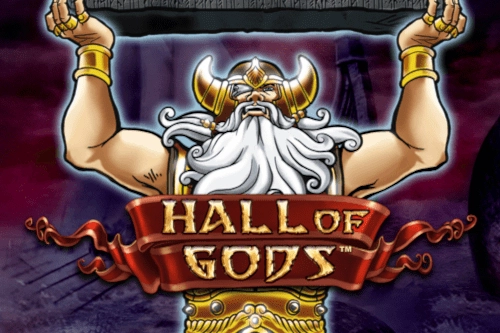
Hall of Gods Review and Free Demo
Game Information

Play the full Hall of Gods slot by NetEnt with free credits. No signup, no deposit and no download needed. The demo runs the same math model as the real money version.
More NetEnt Demos to Try

Where to Play Hall of Gods for Real Money
No operator reaches this list on reputation alone. Our reviewers open a real account, deposit, and take a withdrawal first. The platforms below carry NetEnt games including Hall of Gods and passed our checks on licensing, payout speed and game fairness. 95.7% is the provider default RTP for Hall of Gods. Operators can license a reduced payout version of the same game, so check the paytable in the lobby before you deposit.

- Visa
- Mastercard
- Bitcoin
- Ethereum
- Tether
- Visa
- Mastercard
- Bitcoin
- Ethereum
- Tether
- UPI
- IMPS
- Skrill
- Neteller
- Bank Transfer
- UPI
- IMPS
- Bitcoin
- Ethereum
- Tether
- UPI
- Bank Transfer
- Visa
- Mastercard
- Skrill
- Neteller
- AstroPay
- Tether
- Bank Transfer
- Bitcoin
- UPI
- MuchBetter
- ecoPayz
- Bitcoin
- UPI
- AstroPay
- Skrill
- Neteller
- IMPS
Real-money gambling is not available in Brazil. The demos on this page are free to play, with no deposit and no sign-up.
18+ only. Gambling involves risk. Terms and conditions apply at every operator. Check the laws in your country before playing for real money.
Real-money gambling is not available in Brazil. The demos on this page are free to play, with no deposit and no sign-up.

Almost everything written about Hall of Gods leads with one number, the Mega jackpot, and almost all of it stops there. That is the wrong place to look. NetEnt did not build one prize into this game, it built three, and the bonus round that awards them is a structure with its own internal odds and its own internal pecking order. The Mini, the Midi and the Mega are not three sizes of the same event, they are three separate outcomes whose seed values sit roughly three orders of magnitude apart, which means the worth of reaching the bonus depends almost entirely on which tier turns up rather than on the figure ticking over in the header. This review takes the shield round apart, prices what entering it is actually worth, and looks at the low volatility Norse base game that has to carry you there.
Hall of Gods at a Glance
NetEnt’s own game page dates the release to 22 November 2010 and Bigwinboard agrees on the year, while SlotCatalog and AboutSlots both list 11 November 2013, so we follow the provider and note the split. Stakes run from 0.20 to 50 a spin on NetEnt’s figures, which Bigwinboard, AboutSlots and LCB all repeat, although SlotCatalog lists 0.01 to 100 and two review sites put the ceiling at 100. The volatility rating is unusually consistent for a jackpot game and unusually mild, with four databases calling it low to medium and only one calling it medium. Winning combinations land often, on 37.00 percent of spins by NetEnt’s count and 37.15 to 37.19 percent by the databases. The demo above runs the complete game with play credits, shield bonus included, and no signup.
Hall of Gods Rules Explained Simply
Hall of Gods is a five reel, three row slot on 20 fixed lines, with free spins, expanding wilds and a shield bonus that holds three progressive jackpots. These are the rules from the game’s own information screens and its bonus screens, in plain words.
 How you win5×3, 20 linesThe lines are fixed; you pick a bet level of 1 to 5 and a coin value.Expanding wildSubstitutesThe rules list expanding wild substitutions among the game’s features.Free spinsScatterFree spins and scatter wins are part of the base game.Bonus hammers3 for the bonusThree bonus symbols open the shield bonus game.Shield bonus15 shieldsBreak shields until 3 amounts or 3 jackpot symbols match.JackpotsMini, Midi, MegaThree progressive jackpots, all won inside the shield bonus.Coin prizesIn coinsAmounts behind the shields are coins, so they scale with your bet.RTP95.3% to 95.7%The range stated in the game’s own rules.


The rules pages that matter, from the demo. Click or tap any image to enlarge it, and swipe for more.
How the Hall of Gods Shield Bonus Works Step by Step
Hall of Gods has no bonus buy. The shield bonus is where the jackpots live, and these are its steps as the game showed them in our round.
Our round showed how often the coins win the race. A Midi and a Mini symbol both appeared, but the third 120 came first, and the round paid 120 coins, 6.00 on a 1.00 bet.
Our Hall of Gods Demo Session
Hall of Gods has no bonus buy, so we played the demo at a 1.00 bet, 20 coins at a 0.05 coin value. The shield bonus triggered on our second spin.


Our demo session, in order. Click or tap any image to enlarge it, and swipe for more.
What Our Session Shows
The round always paysOurs ended on three 120s for 6.00.Coins usually win the raceOne Midi and one Mini symbol appeared; neither reached three.The amounts scalePrizes of 120 to 1,500 coins were 6x to 75x the bet at 1.00.Three Jackpots Wearing One Name
The single most useful thing to understand about this game is how far apart its three prizes are. They are not tiers of one jackpot in any meaningful sense. They are three different games sharing a bonus round.
Two independent readings of the seed values agree with each other and they are worth putting side by side. Casinos.com describes the reset levels as multiples of your stake, at two times for the Mini, one hundred times for the Midi and two thousand times for the Mega. CasinoTop10 quotes them instead as flat cash figures of 100, 5,000 and 100,000. Those two accounts are the same account. At the 50 maximum bet, two times the stake is 100, one hundred times is 5,000 and two thousand times is 100,000, so both sources are describing one structure in different units.
Read that structure back and the Mini jackpot resets to roughly the value of two spins. A prize that the game presents with the same fanfare, the same jackpot symbol and the same place in the bonus round as the Mega starts its life worth about as much as the two spins you just paid for. The Midi resets at fifty times the Mini and the Mega at a thousand times the Mini. Calling all three of them jackpots is accurate and also, in terms of what they do to a session, close to meaningless.
The funding tells the same story from the other end. CasinoTop10 breaks the contribution down as one percent of stakes to the Mini, one percent to the Midi and 4.9 percent to the Mega, and AboutSlots independently states that 6.9 percent of the return is diverted into seeding the progressives, which is exactly what those three figures add up to. So roughly seven parts in ten of all the money set aside for jackpots flows to the tier that hits least often, while the tier you are most likely to see reseeds at two times your bet. Where the Mini and Midi pools are held locally by each casino, the Mega is pooled across every operator running the game, which is why the Mega figure grows so much faster and so much larger than the other two.
Inside the Shield Round
Three bonus symbols on the reels open the feature. The screen is replaced by a wall of fifteen shields laid out in the same five by three shape as the reels, and Thor’s hammer smashes the shields you pick. Behind each one is either a coin value or one of the three jackpot symbols.
The rule that governs the round is a match of three. You keep smashing until three of the same coin value have appeared, in which case that coin prize is paid, or until three of the same jackpot symbol have appeared, in which case that jackpot is paid. NetEnt’s own description, Bigwinboard, SlotCatalog and AboutSlots all state the three symbol rule, and the bonus screen itself reads match 3 amounts or 3 jackpot symbols to win. AboutSlots puts it most plainly, the first prize that appears three times is yours. One widely repeated write up claims the round ends on two matching symbols. That is wrong and it matters, because a two match round would end far sooner and would price completely differently.
The second structural rule is that the round cannot pay nothing. Because it continues until some symbol reaches three appearances, every bonus resolves into a prize. That is genuinely unusual and it is the game’s best design decision, but it also sets a trap for the way players remember sessions. A guaranteed win is not the same as a good win. The overwhelming majority of these rounds resolve on a coin value, not on a jackpot symbol, and a coin value is an ordinary slot payout dressed in ceremony.

What Reaching the Bonus Is Actually Worth
Here the sourcing gets thin, so the reasoning is laid out rather than the conclusion. Bigwinboard publishes two probability figures for this game, a Mega hit expectation of 1 in 2,464,171 from the base game and 1 in 26,618 from inside the bonus at maximum bet. We have not been able to trace those numbers to a NetEnt document or to a second independent analysis, and every other appearance of them repeats the same pair, so treat them as indicative rather than certified. What they are good for is showing how the value of a bonus round moves.
Take the 1 in 26,618 at face value for a moment and put a 50 stake against it. When the Mega has just been won and sits at its 100,000 seed, its contribution to the expected value of one bonus round is 100,000 divided by 26,618, which is about 3.76, or under a tenth of your stake. With the pool grown to three million, the same bonus round carries about 113 of Mega expectation, more than twice the stake. At the largest figure this game has ever reached, the same round would have carried close to six times the stake in Mega expectation alone.
| Mega pool at the time | Mega expectation per bonus round at a 50 stake | Expressed as stake multiples |
|---|---|---|
| 100,000 seed | about 3.76 | about 0.08x |
| 1,000,000 | about 37.57 | about 0.75x |
| 3,000,000 | about 112.71 | about 2.25x |
| 5,000,000 | about 187.84 | about 3.76x |
| 7,820,888 record level | about 293.82 | about 5.88x |
That table is arithmetic on someone else’s probability figure, not a certified return schedule, and it deliberately ignores the Mini, the Midi and the coin prizes, which is why it must not be read as the value of the bonus. What it does show is the shape of the thing. The identical shield round, with identical rules and identical odds, is worth about seventy eight times more in Mega expectation at a record pool than it is the day after the Mega drops. No other part of this game moves like that. The paylines pay the same on both days, the free spins pay the same on both days, and the coin prizes behind the shields pay the same on both days.
Two practical readings follow. The first is that a headline jackpot figure is not a feature of the game, it is a state of the game, and a very large advertised Mega is the only circumstance under which this title’s low return figure starts to look defensible. The second is that none of this makes the Mega likely. Improving a one in twenty six thousand shot is still a one in twenty six thousand shot, and it sits behind a bonus round you first have to trigger.
A Mild Base Game Under an Extreme Tail
Strip the jackpots out and Hall of Gods is a gentle game, which is not what most players expect from a progressive. Four of the five databases that rate it put the volatility at low to medium. A winning combination lands on a little over 37 percent of spins. The ceiling excluding jackpots is 4,314 times the bet according to AboutSlots and casinos.com, and 431,400 coins in SlotCatalog’s terms, which is the same figure counted differently, while NetEnt rounds it to 4,300 times. Bigwinboard is the outlier here at 1,200 times.
The base game engine is the Midgard Serpent, which acts as an expanding wild on reels two, three and four and fills its whole reel when it helps a line. That mechanic is why the hit rate stays high without the paytable needing to be generous. Around it sits a free spins layer that is easy to overlook next to the jackpots. Three, four or five scatters award 10, 15 or 20 free spins, every win during the round is tripled, and further scatters retrigger it. A tripled twenty spin round on a game that already hits better than one spin in three is a real feature in its own right, and on the great majority of sessions it is the part of the game that decides how the balance ends up.
The result is a distribution with two completely different halves. The everyday half is frequent, small and forgiving. The other half is a jackpot tail so long that no amount of ordinary play brings it closer. Players who describe this game as tame and players who describe it as a lottery are both right, they are describing different halves.
The RTP You Actually Get
The published return for Hall of Gods is not one number and the spread is worth naming rather than averaging. NetEnt’s own page states 95.70 percent. Bigwinboard publishes a range of 95.3 to 95.7 percent. AboutSlots states 95.5 percent. SlotCatalog’s data field says 95.3 percent while its own review text says 95.5. OnlineSlotsPilot says 95.3 percent. The game’s own rules screen explains the gap: it gives the theoretical return as a range, 95.3 to 95.7 percent, so the 95.70 on NetEnt’s web page is the top of that band and the databases are quoting other points inside it.
Whichever rung applies, that figure includes the jackpot contribution, so the portion of it you can actually collect through ordinary play is smaller than the headline implies. It also sits below what NetEnt’s non jackpot classics return, and well below the studio’s high return titles. The number that governs your money is the one printed on the information screen of the build your casino has loaded, and on a game with this much variation between published figures it is worth opening that screen before you deposit anywhere.
⚠️ One Detail Worth Checking Before You Bet
Who Should Play Hall of Gods
This game suits a player who wants a calm, frequently paying slot and treats the jackpot as a free lottery ticket attached to it rather than as the reason for playing. On that basis it is a reasonable choice, because the low to medium volatility and the 37 percent hit rate mean the base game is not punishing you while you wait, which is more than most jackpot slots offer. It also suits anyone who specifically wants to be playing when a pooled Mega has grown large, since that is the one condition under which the maths shifts in a way you can actually see.
It is a poor fit for anyone chasing a big multiplier from the paylines, since the non jackpot ceiling is modest by modern standards and the return sits well under the studio’s better games. It is a poor fit for clearing wagering requirements, where a higher return matters more than a jackpot you will not hit. And it is a poor fit for anyone who reads a large advertised Mega as a sign that a win is due, because it is not. The game is for players aged 18 and over. Check the return and the jackpot eligibility rules on the information screen, pick a stake you can sustain across hundreds of spins, and set a session limit before the first one.
Verdict and Rating
- Strong: a shield bonus that always resolves into a prize, three genuinely separate jackpot tiers rather than one, a network pooled Mega with a very large record payout behind it, low to medium volatility and a 37 percent hit rate that make the wait cheap, expanding wilds on three reels, and a tripled free spins round of up to 20 spins
- Weak: a published return between 95.3 and 95.7 percent with 6.9 percent of it diverted into the jackpot pools, a Mini tier that reseeds at roughly two times the stake, a non jackpot ceiling of 4,314 times that is modest by current standards, unclear and inconsistently reported rules on whether maximum bet is required for eligibility, and 2010 era presentation
Our rating is 7.9 out of 10. It earns that on the quality of the bonus structure and on a base game that is much easier to sit through than its peers, and it loses ground on a thin return, a bottom jackpot tier that does not deserve the name, and a headline figure that is doing more marketing work than the game does.
Hall of Gods is one of two long running jackpot builds in the NetEnt catalog, the other being Mega Fortune, and the studio’s other classics show what the same maths looks like without a progressive attached. Divine Fortune is the modern take on the same three tier idea, awarding its prizes through a coin grid rather than shields, while Blood Suckers shows how much return is available when nothing is being siphoned into a pool, and Dead or Alive sits at the opposite end of the volatility scale entirely. The full free slots library holds every demo on the site.
